

HENRY ELSOME
What inspired you to become an Engineer? Why did you apply for an Arkwright Engineering Scholarship?
From a young age, I have always been fascinated by new technology, and in particular how things work. This started from building Lego Technic models which progressed to building drones from individually sourced parts to more recently a custom 3D printer. My passion for engineering developed at school through the practical aspects of my Design and Technology lessons and being an active Leader in my schools Greenpower Car challenge team. From the beginning of Year 10, it was my DT teacher, who actively encouraged and supported me to apply for an Arkwright scholarship and since then, I have never looked back.
How did you use your Scholarship funding?
Being an Arkwright scholar gave me confidence when applying for an Engineering based university course as it comes with lots of kudos and prestige. My interviewers were very keen to know more about my scholarship!
The £600 financial aspect of the scholarship was very beneficial as I used it to partially fund my A level Design and Technology project ‘Hydrodapt’ – An Electronically height adjustable Drinking Water Fountain for wheelchair users and children with special educational needs and disabilities (SEND). I was inspired to enter my project into the 2021 Braun Prize product design competition, after looking at the innovative design concepts and use of technology by previous winners.
During the first wave of the COVID-19 pandemic, my scholarship funding allowed me to buy 3D printer filament to print face shield components for the NHS as part of the volunteer group, 3D Crowd UK.
What did you gain from your Arkwright Scholarship? Any stand-out experiences? Did it open any doors for you?
Attending a technology day at BAE Systems Warton in March 2020, (organised by my Arkwright sponsor Team Tempest) sparked my interest in robotics/ mechatronics. It was exciting to learn first-hand about the new technologies that could be utilised by the Tempest fighter jet including Flexible manufacturing systems, Automated guided vehicles, and Additive manufacturing. This day with my sponsor was an amazing experience and confirmed my decision to apply to study Mechatronic Engineering at university – a field that I hadn’t even considered previously!
Where are you studying now, what subject, and how you are finding it so far?
I am a recent Mechatronic Engineering graduate from the University of Manchester. I particularly enjoyed the hands-on, practical elements of the course, including my final-year project, where I designed an Automated Screw Feeder & Dispenser System — an embedded device aimed at helping small-scale manufacturers overcome the challenges of manual fastener handling through a simple, modular, and cost-effective solution.
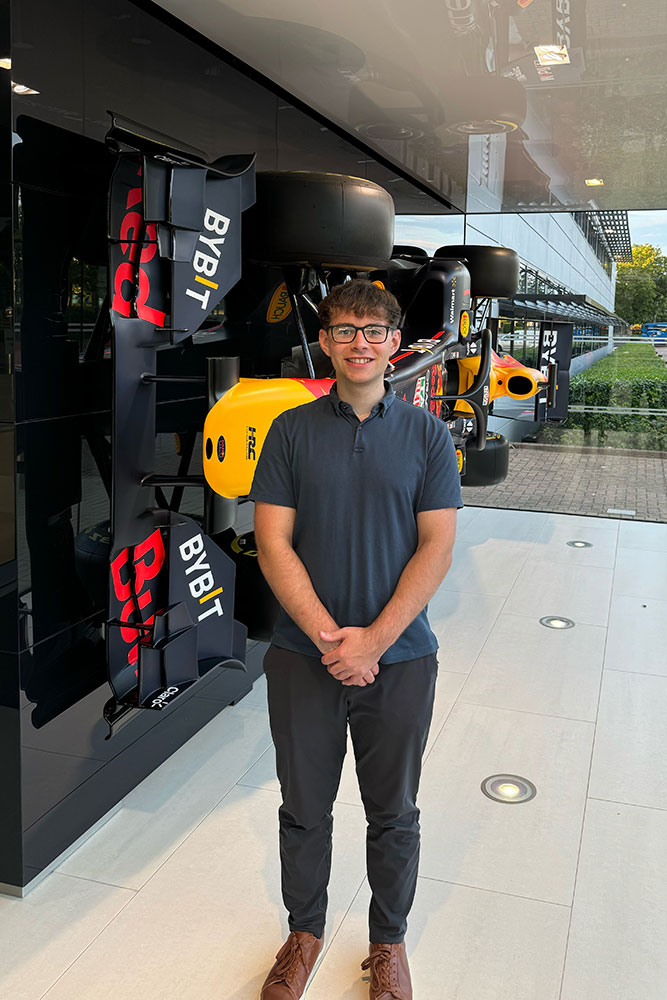
I also completed a 13-month placement as a full-time member of Red Bull Racing Formula 1 Team’s Electronics Department, working as a Student Electronic Design Engineer. During this time, I contributed to the design of both on-car and off-car hardware solutions, pit gear, and test rig equipment. I also produced loom and sensor CAD drawings, system diagrams, build and process documentation, and CAD parts.
Any advice to current Scholars and / or students thinking of applying to Arkwright?
I would say to any students thinking of applying for an Arkwright scholarship to just go for it! Being an Arkwright scholar can open up so many doors and opportunities! I would also urge existing scholars to attend a SmallPeice Trust Engineering course, or any Arkwright connect days/ events organised by your sponsor. These events as well as being fun were invaluable to me as I discovered which Engineering discipline was a good fit for me.
In year 11, my mind was fixed on studying Aerospace engineering. However, after attending a Smallpeice Aerospace Engineering course at Kingston University in August 2019, I was more fascinated by the mechanical and electronic systems of a Lear Jet 25, in particular how the mechanical fly-by-cable technology differs from fly-by-wire electro-hydraulic systems.